Labels

vrijdag 30 december 2016

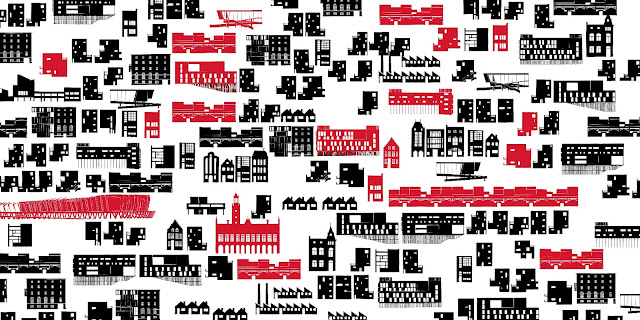
TYPOLOGY - SCHAARBEEK


Check also the article on the site of the Brussels Newsroom!

Cast In Concrete

In collaboration with Valentin Ionescu - Atelier Vast 
Photography by Simon Verstraete.


zondag 22 februari 2015

Theodora Revisited

The first screen print in my new atelier in Brussels! Hand printed on cardboard and paper, image 29 by 29 cm. It tells the story of the city Theodora, one of Italo Calvino's 'Invisible Cities'. The architecture includes buildings by Alvar Aalto (Saynatsalo Town Hall), Le Corbusier (Villa Savoye, Maison Guiette), Gerrit Rietveld (Schroderhuis), Tadao Ando (4x4 house), Victor Horta (Huis Tassel) and myself. If you are interested in acquiring a unique copy you can contact me at thomas.willemse@gmail.com.

zondag 13 april 2014

COSMOS

Not to lose ourselves in the cosmos, we take hold of a reference point in space. We look for a point that is in sharp focus where the contemplation about the cosmos can materialize and find a sheet of paper. With each new line of text – extracted from George Perec’s Espèces d’espaces – an image of the cosmos is taking shape from my personal reference point.

Within this frame of the page the other scale levels can be considered. However, these other levels can never expand beyond the limits of the page as our focus decreases with every increase in scale. Where you can scrutinize every square centimetre of the sheet of paper – and you literally traverse each one with your pen / the ink of the silkscreen print / ... – your bedroom has unknown corners, your house has places covered under a thick layer of dust, ...

With every increase in scale level, the precision of its representation on the sheet of paper drops. The page is represented with a 1 to 1 precision, the bedroom, house street, town, country, continent, earth, cosmos are each time smaller until you end up with the single dot at the centre of the page: a final abstraction.

Thomas Willemse 
March 2014


COSMOS FLIPBOOK


COSMOS SILKSCREEN - BLACK AND WHITE

COSMOS - DEALING WITH THE RELATIVE SIZE OF THINGS IN THE UNIVERSE


zaterdag 28 december 2013

maandag 7 oktober 2013

KORTRIJK

Kortrijk is located at the river Leie, it has its historic core on the small Buda Isle in the middle of the river and is encircled by the almost perfect circle of its ring road. However, this radio-concentric image is deceptive. A dizzying atmosphere of dispersed regional and global entities – which has left the inner city porous with vacant sites – threatens the value of the inner city’s centrality. Counterintuitively Kortrijk is not a radio-concentric city, but reveals a ladder structure between the regional connectors of the Leie and the E17 with perpendicular to these axes the local north-south connections.

Perhaps these north-south rungs of the ladder can succeed where the circular figure of the ring road failed: to span the city and stitch the successive expansions of Kortrijk back together. The city is no longer a radial bullseye with a dense urban heart, surrounded by ever more open rings to end in the open countryside, but instead a hybrid city form within the ladder frame. In this way a subforest becomes part of both city and countryside by mixing forest and fields – agroforestry – and forest and houses – allotment forestry. By abolishing the redundant west-ring the gap left by the oversized car infrastructure could complete this image: Instead of having green villages with tree-filled gardens, it becomes a forest with clearings for the villas. Emphasizing the strengths and diversity of the sprawling city rather than superimposing an outdated view of the quintessential city, reveals an otherwise unnoticed wealth of this new kind of city form.

Thomas Willemse

October 2013


dinsdag 11 juni 2013

CONEY ISLAND

ISLAND OF ISLANDS

It seems as if history repeats itself at the narrow peninsula of Coney Island where the strange juxtaposition of enclosed escapist realms was cleared once again. Quintessentially a natural refuge for the people of the ever-denser Manhattan, with its wide shores, salt marshes and the exceptionally large population of rabbits – or konijnen in Dutch – that gave it its name, the island soon had to cope with an overpopulation of people instead. The island had to transform itself into something new to keep on offering a place of escape and refuge; it became something super-natural. It turned itself into the total opposite of nature to counteract the artificiality of the metropolis. New closed-off islands take shape: Steeplechase Park, Luna and Dreamland, their extra-terrestrial, highly artificial and fragile atmospheres shielded from their surroundings. At the same time another locked-off world is created a little further: Sea Gate, a private gated community of single-family homes, equally turning its back to its neighbors. The mere geographical and natural separation of the island no longer suffices to escape from the metropolis; new small realms are formed in its interior, all carrying that spirit of stepping outside the every-day life. However, the ‘End of the World’ attraction of Dreamland literally becomes this world’s end when it short-circuits in May 1911 and starts a fire that burns Dreamland to the ground. Three years later Luna Park too goes up in flames. A lone rollercoaster stands in the ashes of the cleared ‘super-natural’: a first clearance in its history. The gap is rapidly closed by city planner Robert Moses when he creates new un-natural enclaves by transforming fifty percent of Coney Island into parks.

However, in October 2012 the shores of the island were once again swept clean, this time by Hurricane Sandy. The remaining fun fair was once more heavily hit, leaving the rollercoaster in the middle of a sea of water this time. Sea Gate was struck by an equal force of water that swept through many of the beach houses. But something else has also happened: the artificial barriers, protecting the ‘super-natural’ inside, have been breached, blurring the escapist ambitions of one realm with those of another. The ‘naturally restored’ dunes of the Coney Island Creek Park shifted and buried the delineating fence of Sea Gate – and the lower levels of some houses – erasing this once so sharp border. Yet perhaps even stronger breaches were slashed in the social barriers, bringing alienated neighbors back together in the recovery afterwards. Perhaps some bridges will remain between the islands, even if the ever-shifting sands reveal the physical barriers once more.

Thomas Willemse
April 2013


zondag 10 februari 2013

Fragments of Cities

Everybody forms an idea of a city in his mind, a fragmented concept made up of an amalgamation of encounters with the city, of experiencing, reading, designing, imagining, ... cities. Here follows my personal account ...


Click on the image above for an interactive view on the city ... - created for 'Global Exchange Combodia'

zondag 16 september 2012

Beihuoday-Yaoshang, Anderlecht, Nazareth, Evora

BEIHUODAY-YAOSHANG

As the expansion of the vast metropolis Beijing keeps on speeding up, village upon village of neatly arranged rows of equal courtyard houses, all facing the same direction, are wiped out. Walled compounds with row upon row of shiny new high rise blocks, all facing the same direction, appear where just a few months before the rows of siheyuan courtyard houses formed a walled farming village. Working in the lotus ponds has been abandoned for an office job, the courtyard house has been replaced by a 25th storey apartment, the tricycle by the latest new car model, the bustling streets by enormous highway traffic jams. 

As the new life rolls from the epicentre of the Forbidden City it reaches Beihuoday-Yaoshang at the sixth ring road. No time to waste on demolition, it spreads over the village. New streets appear on the terracotta tile roofs, houses are erected around the former courtyards, electricity, water, sewage, internet appear, the old town is covered. But when you look closely at the new layer you start seeing a pattern of communal courtyards facing the same direction, holes where jujubee trees appear popping out from the smaller courtyards below, an intricate pattern from public to private, repeated on all levels. The village is still there giving shape to the new city.

ANDERLECHT

Cities are on the one hand made of houses, corner shops, libraries, cinemas, high-rise office towers, garages, factories, but maybe even more by the interconnection of all these pieces and the interconnection between the cities themselves. As a result the areas around the cities are covered by complex patterns of roads in the shapes of a pentagon, a circle or a straight line radiating from the centre. Here you can find railway lines crossing a canal or a road, each trying to find the right course. But now the jungle of the city reaches this outer fringe covered with overlapping and criss-crossing traffic lines. 

Still, housing takes root in the irregular armpit of an intersecting street, railroad and canal. The houses cannot but adapt. Some pop up as a large tower to distance themselves from the jumble below, but for the others high facades appear on all the borders as response to the large surrounding figures: the railway track, the tower, the road. But when you enter you see each house reaching for light, opening up to create a private spot hidden from the tower, covering an open space next to the entrance. These are individual reactions to their surroundings: a terrace on the top floor, an introvert logia halfway up, a carport at ground level. The opening up or closing off according to their position generates a range of clearly related but distinctly different forms, just like the crooked shapes of the trees at the border of a forest. The city is maybe not a tree, but perhaps a forest.


NAZARETH

The city of Nazareth has all the quintessential Arab characteristics: white houses climb the ridiculously steep hillside where the shadowy streets are overrun by the colourful merchandise of the shopkeepers of the local souk. But to navigate the labyrinth of small passages between the White Mosque, the Muslim Mausoleum, the Orthodox church, the Roman church, the Coptic church, the Baptist church and many religious sanctuaries, you have to know that next to the extreme topography this city is dictated by a particular sequence of successive places. From the congested main street you can easily trace the sequence via the bustling souk to ever narrower alleys until you reach the private terraces in the inner patio of the hámula, the family house.

But right in the middle of the city all steps of the sequence converge on one spot, shortcutting the intricate balance and juxtaposing congestion and desolation. Only in height can the sequence be restored, stacking one square on top of another, one patio in another, one roof over another. Not only outside, but also inside one activity follows another generating interwoven complex gradually changing spirals. At this junction you can truly find the vertical city. 


EVORA

If I wanted to describe Alvaro Siza’s residential housing neighbourhood in Malagueira, I could start tracing back the steps in history. I could talk of the meandering path the gypsies used to take to go and fetch water from the fountains. Or I could even go back to the ancient stone arches of the aqueduct of the old Evora town centre and how they are mirrored in the grey blocks that form square openings under a raised carrier casting its shadow on the neighbourhood. I could describe how the many white houses follow the contours of the hilly Portuguese landscape, overlooking the green fields running alongside the stream. 

But to do this I would have to talk about the asphalt of the slightly winding road that crosses the entire area, or about the water and gas pipes, the electricity, television and telephone lines that are distributed on a raised aqueduct, or about the efficiency with which all identical white houses are placed on a rigid grid. It is clear after this description that the Malagueira district spans two worlds, following both old and modern principles, and that its true building component is in fact time.


vrijdag 14 september 2012